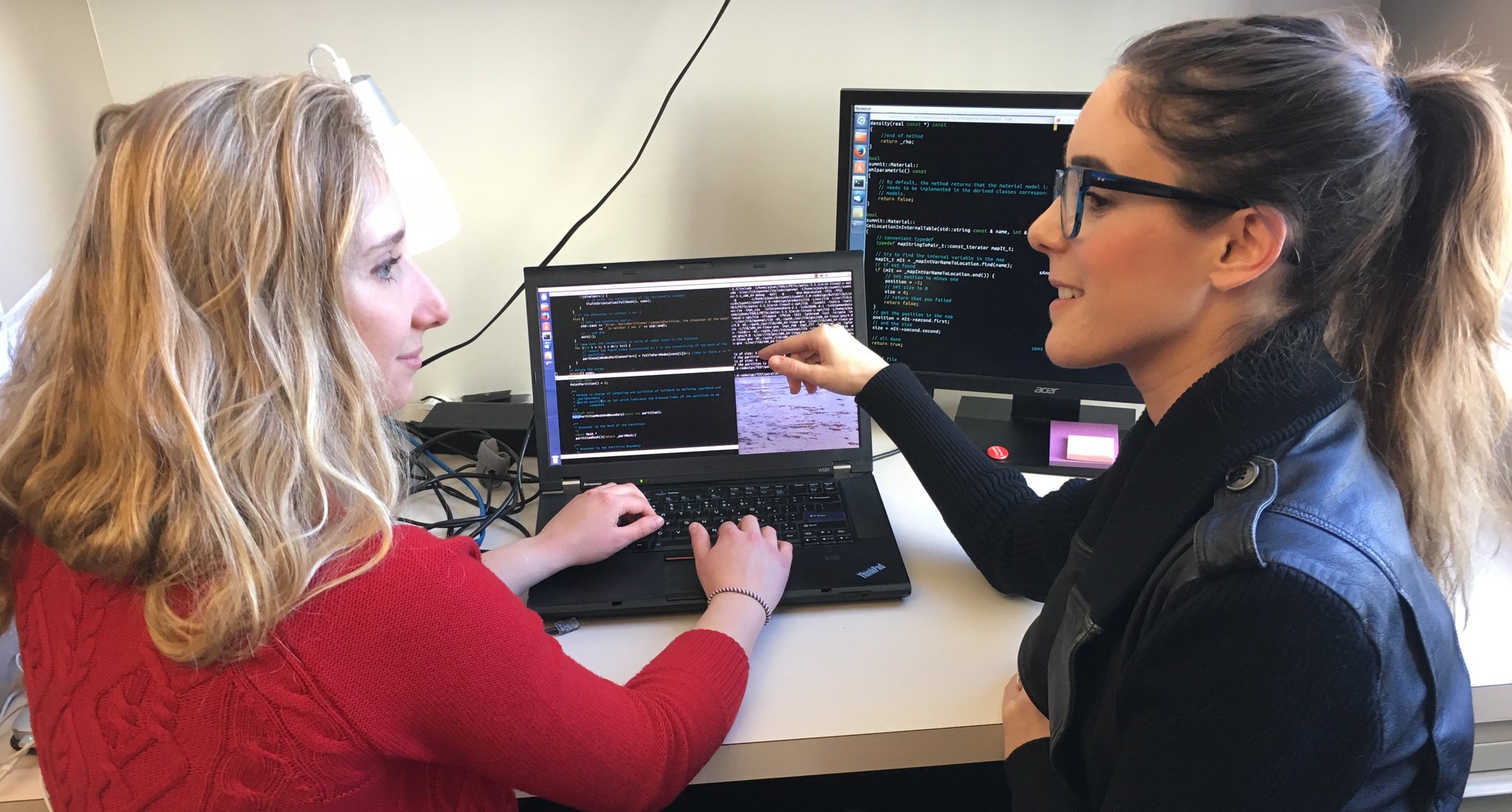
MEET: DAMIEN CAVAILLES & RAPHAEL LUTA, 2 INSPIRING DEVs

Bonjour à tous!

Nous nous retrouvons après un peu d'absence mais celle-ci valait le coup puisque j'ai eu l'honneur d'interviewer deux Développeurs, Damien Cavaillès (@TheDamfr) et Raphaël Luta (@raphaelluta). Autant vous dire que j'étais assez excitée (je crois que j'ai secrètement toujours voulu être une Dév dans une autre vie) à l'idée de pouvoir discuter et échanger avec eux étant donné mon admiration pour leur profession, qu'ils exercent avec une grande passion mais aussi pour leur capacité et volonté à vouloir partager avec leurs égaux ou des novices comme moi :)
Je remercie Shirley (son interview ici) de m'avoir mise en relation avec eux et vous je vous laisse maintenant à cette lecture qui j'en suis sûre vous fera découvrir leur univers et changera votre vision des choses.

Hello everyone!

We meet again after a bit of silence but it was worth it as I had the honour to interview two Developers, Damien Cavaillès (@TheDamfr) and Raphaël Luta (@raphaelluta). I have to confess that I was pretty excited (I think I secretly wanted to be a Dev in an other life) with the idea of discussing and exchanging with them as I admire a lot their profession, which they practise with a great passion but also for their capacity and will to share with their peers or beginners like me :)
I also thank Shirley (her interview here) to have put me in touch with them and I now leave you with your reading which I am sure will make you discover their environment and will change your vision.


1. Damien, Raphaël, pouvez-vous vous présenter et nous dire qui vous êtes… 

Damien: Je suis développeur et entrepreneur ! J'ai commencé à coder au collège. D'abord des sites web en PHP, puis du C++ et du Java. Ensuite j'ai fait un diplôme d'ingénieur avec un MSc CS au Québec, "c'était le fun !". Je me suis découvert une fibre entrepreneuriale étant étudiant. Aujourd'hui Fondateur de JeChercheUnDev.fr, je construis une entreprise qui a pour mission d'aider les développeurs à trouver leur job de rêve !

Raphaël: Ingénieur de formation, je suis un consultant indépendant depuis presque 15 ans, après diverses expériences en grand groupe et start-up.
J'écris du code quasiment tous les jours, pas forcément dans le but de livrer un logiciel fini mais plutôt comme un outil pour réaliser mes objectifs : automatiser des processus, analyser des données ou encore valider des concepts de produit via un prototype.
Je suis également membre de la fondation open source Apache et intervenant dans le Master de Commerce Électronique de l'UPEC où je donne un cours sur la sécurité du web à des élèves de formation plutôt marketing.

2. Vous êtes développeurs, qu’est-ce qui vous a poussé à vouloir le devenir? 

Damien: Le développement c'est un peu comme la cuisine ! On sait tous déjà en faire un peu, et ensuite, on y investit du temps, de la passion pour continuer à créer et à apprendre. Au final, j'ai pas l'impression d'avoir choisi de devenir développeur. C'est plus quelque chose qui s'est installé au fil de l'eau !

Raphaël: Enfant, j'ai vu apparaître les premiers ordinateurs personnels (Apple 2, ZX 81, Commodore 64 et autres Amstrad...) et j'ai immédiatement été captivé par leurs capacités. J'ai donc appris à programmer en Basic vers 10 ans car c'était le seul moyen de leur faire faire quelque chose d'intéressant ! La suite s'est faite naturellement, j'ai choisi mon école d'ingénieur pour faire de l'intelligence artificielle et quand j'y ai découvert le réseau et le web en 1994, j'ai compris que je ferai ma carrière dans ce domaine.

3. Qu’aimez-vous le plus et le moins dans votre métier? 

Damien: Le plus passionnant, c'est clairement le temps passé avec les utilisateurs. C'est pour ça que j'aime développer des applications mobiles. Il y a beaucoup de terrain etc…
La partie la plus pénible pour moi correspond plus au fonctionnel, la gestion des spécifications etc… Quand les tickets s'ouvrent toute la journée !

Raphaël: Il y deux choses que je trouve très plaisantes. D'un côté la satisfaction très solitaire de réussir à régler un problème compliqué avec un code simple, élégant et performant; l'autre le plaisir de collaborer avec des utilisateurs et des designers pour faire émerger une solution technologique à un besoin réel. Je rejoins Damien sur les parties plus pénibles qui sont clairement les activités fonctionnelles et de gestion de projet.

4. On découvre de plus en plus de meetups, d’ateliers et de stages d’initiation pour les enfants… Que pensez-vous de ce nouvel élan d’intérêt pour le code? 

Damien: Quand on est jeune, on apprend plus facilement. Les déclics, la façon de penser, les raisonnements sont plus facile à apprendre quand on est jeune!

Raphaël: Complètement d'accord avec Damien. Cela est probablement très bénéfique pour un enfant mais il faut que cela reste une activité volontaire et pas une contrainte.

4a. Pensez-vous que cela soit une vraie ou fausse bonne idée?  

Damien: C'est une vraie bonne idée !

Raphaël: C'est une excellente chose de permettre à toutes personnes intéressées, quelque soit leur âge, d'apprendre à développer. Dans le milieu des développeurs, il y a une forte culture de partage et d'apprentissage continu, d'abord entre nous via les meetups techniques et les projets open source mais de plus en plus vers une communauté plus large.
Je pense que c'est également une des raisons pour lesquelles on voit se multiplier les initiatives d'apprentissage du code, nous avons envie de partager notre passion. D'ailleurs dans le meetup d'apprentissage auquel j'ai participé, il y avait plus de développeurs "tuteurs" que "d'élèves" désirant apprendre !

4b. Quels conseils donneriez-vous aux personnes qui souhaitent découvrir et pratiquer? 

Damien: Souvent je conseille de commencer avec quelques cours sur OpenClassroom. Les formations comme Le Wagon, Simplon ou WebForce3 permettent de bien approfondir les choses. Pour aller plus loin, on peut prendre des modules de cours au CNAM, voire même y suivre une formation donnant un diplôme d'ingénieur !

Raphaël: Personnellement, je recommande de se fixer d'abord un but : pourquoi j'ai envie de coder ? Une fois un objectif défini, il est plus facile de choisir comment commencer. Par exemple, pour quelqu'un qui voudrait se développer ses propres jeux vidéo, des ateliers Scratch ou modding Minecraft conviennent parfaitement pour découvrir et réussir à faire quelque chose rapidement; si la finalité est plutôt de se faire son propre site web ou mobile, des MOOCs comme OpenClassroom, CodeAcademy etc... sont bien adaptés.

5. Qu’aimeriez-vous que l’on arrête de vous dire? (les fameux stéréotypes… ;) 

Damien: On considère souvent les développeurs comme productif, des cols bleus. C'est très réducteurs. Nous créons des expériences numériques, nous résolvons des problèmes complexes, nous sommes créatifs. J'aime voir des développeurs qui font du produit, du marketing, de la communication ou autre. A brider les développeurs, on les empêche de s'épanouir, c'est un cercle vicieux. Pour le briser, j'encourage les développeurs à sortir de leurs zone de confort et à exceller là où on ne les attend pas !

Raphaël: Il y a tellement de stéréotypes à dénoncer que c'est dur de faire un choix ! Celui qu'évoque Damien est un vrai problème. Personnellement, j'ai également entendu pendant longtemps que je devrais envisager "d'évoluer" vers des métiers comme la gestion de projet ou l'encadrement comme si "la technique" n'était pas une activité pour quelqu'un de plus de 30 ans.

6. Comme pour chaque participant, je vous laisse la sixième et dernière question comme tribune. Vous pouvez l'utiliser ou non et partager avec les lecteurs ce que vous désirez :) 

Damien: Aujourd'hui, plus de 60% des développeurs ne sont pas heureux d'aller au travail le lundi matin. Je mène l'enquête pour comprendre le pourquoi du comment ! Si vous avez des indices, envoyez-nous les éléments à hello@jechercheundev.fr

Raphaël: Je pense qu'il faut aussi aller au delà de la notion de "développeur" : toute personne sachant développer n'est pas nécessairement un développeur professionnel tout comme toute personne sachant parler anglais n'est pas nécessairement traducteur ou interprète. Un comptable ou un commercial sachant coder a juste accès à une plus grande panoplie d'outils pour réaliser son travail ce qui lui permettra d'être plus efficace. Vu l'importance qu'ont pris les ordinateurs dans nos sociétés, on y gagnerait tous à ce que les compétences informatiques soient mieux diffusées dans la société et pas réservées à une population de purs professionnels spécialisés.

Source: lestalentsdalex.com

1. Damien, Raphaël, can you introduce yourselves and tell us who you are… 


Damien: I am a Developper and an Entrepreneur! I started to code when I was in middle school. First, websites in PHP, and then C++ and Java. Following that, I studied and graduated from an Engineering School with a MSc CS in Quebec, 'it was a lot of fun!'. I found out that I had an entrepreneurship mindset whilst I was a student. Today, I am the Founder of JeChercheUnDev.fr (I Am Looking For A Dev), I am building a company which aims to help developers to find their dream job!

Raphaël: I am originally an Engineer, I am now and have been an independent consultant for almost 15 years, after several different experiences in big corporation and start-up.
I write code almost every day, not necessarily with the goal of delivering a finished software but more like a tool to achieve my objectives: automate processus, analyse data or validate concepts of products via a prototype.
I am also a member of the open source foundation Apache and a speaker in the Master's Degree of Electronic Commerce at UPEC where I teach a course about web security to students with a more marketing background.

2. You are developers, what pushed you to become one? 

Damien: Developing is a bit like cooking! We already all know how to do it a bit, and then, we invest time, passion to keep on creating and learning. In the end, I don't feel I chose to become a developer. It is more something that built up along the way.

Raphaël: When I was a child, I saw the birth of the first personal computers (Apple 2, ZX 81, Commodore 64 and other Amstrad...) and I was directly captivated by their capacities. So I started to code in Basic when I was about 10 because it was the only way to make them do something interesting. The rest came naturally, I chose my engineering school to do artificial intelligence and when I discovered the network and the web in 1994, I knew that I would make my career in this field.

3. What do you like the most and the least in your job? 

Damien: The best and most engaging moment is clearly the time we spend with the users. That's why I love to develop mobile apps. There is a lot of discussions and testings etc...
For me, the most annoying time corresponds to the functional part, with the management of specifications etc... When tickets open and come all day!

Raphaël: There are two things I enjoy a lot. On one hand, the very self-satisfaction of success when solving a complicated problem with a simple, elegant and performant code; on the other hand, it is the pleasure to collaborate with users and designers to create a technological solution to a real problem. I agree with Damien on the most annoying parts which are clearly functional activities and project management.

4. We more and more find out about meetups, workshops and training couses for children... What do you think about this new momentum for coding?

Damien: When you are young, you learn with more ease. Things falling into place, way of thinking, reasonings are easier to learn when you are young!

Raphaël: Totally agree with Damien. It is probably very beneficial for a child but it has to stay a voluntary activity and not a constraint.

4a. Do you think it is a real good idea or a false good idea?  

Damien: It is a real good idea!

Raphaël: It is an excellent thing to allow any interested persons, whatever their age, to learn how to code. In the world of developers, there is a strong culture of sharing and continuous learning, firstly between each other with technical meetups and open source projects but more and more with a broader community.
That's why I think it is one of the reasons we see the multiplication of initiatives to learn how to code, we want to share our passion. By the way, in the learning meetup in which I took part, there were more 'tutoring' developers than 'students' wanting to learn!

4b. What advice would you give to people who want to discover and practise? 

Damien: I often advise to start with some courses on OpenClassroom. Trainings like Le Wagon, Simplon or WebForce3 allow to deepen your knowledge. To go further, you can take modules of courses at the CNAM (National Conservatory of Arts and Professions (Métiers)) and by following a formation you can even get an engineering diploma!

Raphaël: Personally, I recommend to set yourself a goal: why do I want to code? Once the objective is set up, it is easier to chose how to start. For example, for someone that would like to develop their own video games, Scratch trainings or Minecraft modding are totally suitable to discover and quickly succeed in doing something; if the purpose is more to make your own web or mobile site, MOOCs like OpenClassroom, CodeAcademy etc... are well adjusted.

5. What do you wish people would stop saying? (the infamous stereotypes... ;)

Damien: We often consider developers for being productive, blue collars. Is it really reductive. We create numerical experiences, we solve complex problems, we are creative. I like to see developers doing product, marketing, communication and other things. By restraining developers, you do not allow them to be happy and satisfied, it is a vicious circle. To break it, I encourage developers to get out of their comfort zones and to excel where nobody expects them.

Raphaël: There are so many stereotypes that it is hard to make a choice! The one that Damien talked about is a real problem. Personally, I have heard during a long time that I should consider an 'evolution' towards positions like project management or classic management, as if the 'technic' was not an activity for someone older than 30.

6. As for every interviewee, I leave you the sixth and last question as a tribune. You can use it or not and share whatever you like with the readers :)

Damien: Today, more than 60% of developers are not happy to go to work on Monday morning. I am investigating to understand the why and how! If you have clues, send us the elements at hello@jechercheundev.fr

Raphaël: I think that we need to go above the notion of 'developer': each person knowing how to develop is not necessarily a professional developer just like every person knowing how to speak English is not a translator nor an interpret. An accountant or a business rep who knows how to code will just have access to a wider variety of tools to realise its job which will allow them to be more efficient. Given the important place that computers took in our society, we would all win if IT competencies where more spread out in the society and not only kept to a population of pure specialised professionals.

A big THANK YOU to you both and to be continued in the next episode, Amélie X

Un TRES GRAND MERCI à vous deux et la suite au prochain épisode, Amélie X

MEET: LAURENCE KERJEAN, USING DIGITAL TO HELP A GREAT CAUSE

Bonjour à tous!

Je suis ravie de vous retrouver pour un nouvel épisode de la série 'MEET'. 
Aujourd'hui, j'aimerais vous présenter Laurence Kerjean (@laurencekerjean), une personne fabuleuse au parcours (d)étonnant! Elle utilise le digital pour la bonne cause puisqu'elle s'investit dans la lutte contre le gaspillage alimentaire et a créé deux entreprises innovantes qui je suis sûre vont révolutionner la vie de chacun de nous!
Vous souhaitez en savoir plus? C'est en dessous que ça se passe.

Hello everyone!

I am pleased to meet you again in a new episode of the 'MEET' serie.
Today, I wanted to introduce you to Laurence Kerjean (@laurencekerjean), a fabulous person with an amazing background! She uses digital for the good cause as she wants to fight against food waste and created two innovative companies for that, and I am sure they will revolutionise everyone's life!
Want to know more? Scroll down below.

Laurence Kerjean
1. Laurence, peux-tu te présenter et nous dire qui tu es... 

Je m’appelle Laurence Kerjean, j’ai 39 ans et je suis Marseillaise à 100%. D’ailleurs, ayant grandi dans les quartiers Nord de Marseille, rien ne me prédestinait à faire des études et encore moins à occuper les postes que j'ai eus dans de grands groupes du CAC40. 
Et pourtant après un bac Littéraire, j'ai intégré Sciences Po puis l'ESCP avant de décrocher un stage de fin d'études chez Louis Vuitton Europe, qui m'a ouvert la porte de mes postes suivants chez Selfridges et L'Oréal. Un parcours assez classique si ce n'est que j'ai commencé ma carrière à l'étranger (Madrid, puis Londres) avant de revenir en France en 2008. Tout ce parcours peut paraître assez classique pour des cadres Parisiens mais pour moi, dont les parents n’ont même pas le bac, ça ne l'était pas et je me suis toujours beaucoup investie pour donner le meilleur de moi-même. 
Malgré tout le désir d'entreprendre a toujours été là et la difficulté quand on vient d'où je viens est de savoir renoncer au confort du statut de cadre, si durement acquis, pour l'inconnu de l'entreprenariat. Mais il arrive un moment où il faut savoir être en adéquation avec ses valeurs et ses envies. 
Après 15 ans dans la mode et les cosmétiques j’ai décidé que rendre le monde plus beau ne me suffisait pas et que je voulais aussi le rendre meilleur. 
Maman de 3 enfants, j’ai choisi un thème qui me touche particulièrement: le gaspillage alimentaire. 

2. Tu es passionnée de digital, comment cette passion t’est-elle venue? 

Plusieurs facteurs ont contribué à me plonger dans le digital: 
D’abord j’ai commencé ma carrière en CRM quand tout était encore sur papier mais très vite on a commencé à gérer d’énormes bases de données et on a lancé des sites internet donc un peu comme Obélix, je suis tombée dans la marmite du digital dès mon premier stage; 
Ensuite, même si j’ai longtemps occupé des postes de marketing dit classique (= produit), je n’ai jamais laissé tomber l’aspect digital, essayant toujours d’insuffler de la nouveauté via les outils connectés et c’est justement sur cette base-là, qu’au retour de mon premier congé maternité, les RH ont pensé à moi pour la création d’un poste 100% digital dans la division où je travaillais à l’époque. 
J’ai saisi cette opportunité à bras le corps pour faire du digital un point fort et mon point de différenciation aussi. J’ai été la première à organiser un hackathon de la beauté , à l’époque où très peu de personnes savaient ce que cela voulait dire, et j’ai commencé à beaucoup fréquenter l’univers des startups- à partir de là, le ver était dans la pomme :) 
Et puis, je ne peux pas ne pas mentionner le fait d’être mariée à un geek, ce qui favorise les interactions avec la technologie et le digital au sens large. Notre hashtag sur les réseaux sociaux est d’ailleurs la #geekfamily ! 

3. Tu as créé et dirige maintenant deux entreprises, MeetZEChef (@meetZEchef) et lefrigojaune (@lefrigojaune). Peux-tu nous expliquer en quoi elles consistent et pourquoi tu as souhaité les créer. 

L’année dernière a été chargée à tous points de vue pour moi : un nouveau bébé, un épisode personnel douloureux et la perspective d’avoir 40 ans, je crois que j’avais envie de me lancer depuis longtemps et que là tous les astres étaient alignés. J’ai choisi un projet auquel je crois, qui correspond à mes valeurs et pour lequel j’ai envie de me battre chaque jour. 
En réalité j’ai d’abord lancé meetZEchef, une plateforme de mise en relation entre particuliers pour lutter contre le gaspillage alimentaire, et au bout de quelques mois, on a bien vu que le concept plaisait mais avec 80% des échanges à 0€, et un travail de conversion titanesque, on s’est vite posé la question de notre survie économique car pour avoir un véritable impact il faut durer. C’est à ce moment-là que s’est présenté le hackathon Women Innovation d’Orange, qui nous a servi de tremplin pour pivoter et lancer lefrigojaune, un modèle B2B de lutte contre le gaspillage alimentaire. 
En réalité, lefrigojaune c'est une réponse fun, engageante et sans culpabilité au gaspillage alimentaire mais c’est surtout un véritable projet d'entreprise qui apporte du sens, recrée du lien, engage tous les employés et contribue à la marque-employeur au bénéfice de tous. 

4. Le digital est au coeur de tes entreprises, quel est le rôle de celui-ci, son influence? Est-ce uniquement une fonction support? Un meilleur moyen de communication auprès de ta cible?... 

Je suis persuadée qu'on vit actuellement une véritable révolution de paradigmes et j'y ai vu l'occasion d'y participer activement. En ce sens le digital est surtout un outil qui me permet de mener à bien mon projet. Ce n’est pas une fin en soi mais le meilleur moyen pour arriver à atteindre cet objectif d’anti gaspillage que l’on vise. En plus je suis assez contente d’utiliser la technologie dans un but positif et de prouver que le digital ne sert pas qu’à nous éloigner mais peut aussi nous rapprocher et recréer du lien. Comme avec chaque innovation, ce n’est pas tant l’outil qui importe que l’utilisation qui en est faite. 

5. Tu vas être speaker à la #JFD17 

5a. Sans faire de teasing, quel est le message que tu souhaites y faire passer? 

Je souhaite partager mon expérience autour du thème de l’exploration de nouveaux business modèles. Je veux témoigner du fait qu’on peut faire du business différemment et avoir un objectif social et positif en gagnant sa vie, cela ne doit pas être incompatible. Et puis évidemment le message de l’anti-gaspillage reste prépondérant pour lefrigojaune même si nous l’envisageons de manière très décomplexée et pas culpabilisante , un doggy bag à la fois en quelque sorte. 

5b. Que représente cet événement pour toi? 

Fan de la première heure de la JFD, je suis 100% convaincue que le digital est une opportunité pour l’humanité et surtout pour la femme. Le digital me permet chaque jour de vivre selon ma maxime préférée de Mark Twain : ‘Ils ne savaient pas que c’était impossible, alors ils l’ont fait’ et typiquement, je ne vous aurais pas cru si vous m’aviez dit il y a 5 ans que je serais invitée à parler sur la scène de la JFD. C’est donc une opportunité incroyable, la concrétisation d’une idée née il y a 3 mois à peine, et pour laquelle je tiens à remercier les équipes organisatrices du hackathon #WInov et tout particulièrement Viviane de Beaufort, Carol Junger, Christine Rabret et l’équipe de la JFD et the bureau. 

6. Comme pour chaque participant, je te laisse la sixième et dernière question comme tribune. Tu peux l'utiliser ou non et partager avec les lecteurs ce que tu désires :) 

Un dernier clin d’oeil en image pour la JFD. Que vous soyez une femme, que vous en côtoyiez ou que vous en éleviez une, pensez à l’encourager à chaque étape. 


1. Laurence, can you introduce yourself and tell us who you are… 

My name is Laurence Kerjean, I am 39 and 100% from Marseille (ie: for non-French readers, Marseille is situated in the South of France and locals are really proud to say they are from there, even more when they are established in Paris as both cities are in opposition, especially when it comes to football ;). By the way, I grew up in the Northern city council of Marseille (ie: if you don’t know Marseille, that part of the city is unfortunately not the fanciest and there is a high rate of unemployment especially in the young population…), nothing was predestining me to enrol in higher studies and even less to take on positions I used to have for big Groups of the CAC40.
However, after I passed my High School Diploma focusing on Literature, I enrolled at Sciences Po and then ESCP before I got my final year internship at Louis Vuitton Europe, which opened me the door to my following missions at Selfridges and L’Oréal. A very classical path except for the fact that I started my career abroad (Madrid and then London) before coming back to France in 2008. All this can appear very classical for any given Parisian Managers, but for me, whose parents do not even have High School Diplomas, it was not the case and I made a point to be very invested in order to give out the best of myself.
Despite all, the desire to begin doing something as an entrepreneur has always been there and the difficulty when you come where I am from is to renounce about the comfort of being a Manager, acquired after so many efforts, for the unknown of entrepreneurship. But there is a time when you need to be in harmony with your values and needs.
After 15 years in fashion and cosmetics, I decided that making the world more beautiful was not enough for me and that I also wanted to make it better.
Mother of three, I chose a theme that particularly touched me: food waste.

2. You are passionate about digital, where did that passion come from? 

Several factors contributed to throw me in the digital world:
First of all, I started my career in CRM when everything was still made with paper but very quickly, we started to deal with huge databases and we launched websites so a bit like Obélix, I fell in the digital marmite as soon as I started my first internship (ie: French character from the comic book ‘Astérix et Obélix’, who is unbelievably strong as a result of him being dropped off unintentionally in a magical marmite when he was young. It has now become a common expression to say that you are good at/passionate about something but it all started unexpectedly);
Then, even if I did take so-called Classic Marketing roles (= products-focused) for a long time, I never let down the digital aspect, always trying to inject newness using connected objects and it is exactly thanks to this will, right after I came back from my first maternity leave, that HR thought about me for the creation of a new role 100% focusing on digital in the division I was working in at the time.
I determinedly took this opportunity to make digital my strong point but a differentiation factor as well. I was the first person to organise a beauty hackathon, at a time where only few people knew what it was, and I started to spend a lot of time in the start-up environment, from that moment on, the wheels were in motion.
And, I cannot not mention the fact that I am married to a geek, which boosts interactions with technology and digital in every sense.
By the way, our hashtag on social media is the #geekfamily !

3. You created and now manage two companies, MeetZEChef (@meetZEchef) and lefrigojaune (@lefrigojaune : The yellow refrigerator). Can you tell us what these are all about and why you wanted to create them. 

Last year was very busy for me: a new baby, a painful personal moment and the perspective to turn 40, I think I wanted to start something since a long time ago and at that time all the stars were aligned. I chose a project in which I believe, in agreement with my values and for which I would like to fight every day.
In reality, I firstly launched meetZEchef, a platform where any private individual could connect with another one to fight against food waste, and after few months, we saw that the concept was liked but with 80% of exchange done for a 0€-price tag, and a huge conversion work, we asked ourselves about our economical viability because if you want to have a real impact you need to last. This is at this particular moment that we heard about the Women Innovation hackathon from Orange, which we used as a springboard to move and launch lefrigojaune, a B2B business model to fight against food waste.
In reality, lefrigojaune is a fun, engaging and guilt-free answer to food waste but also a real company project which brings sense, recreates bond, engages all employees and contributes to the employer brand for everyone’s benefit.

4. Digital is at the core of your companies, what is its role, its influence? Is it only a support function? A better way to communicate to your target?... 

I am convinced that we are currently living a revolution of paradigms and I saw the occasion to participate actively. In that sense, digital is a special tool that allows me to complete my project successfully. It is not an end in itself but the best way to reach this goal of non-food waste that we are targeting. Furthermore, I am quite happy to use technology in a positive way and to prove that digital does not necessarily separate us but can also bring us closer to each other and recreate bond. As for every innovation, it is not about the tool itself but the use that is made out of it. 

5. You will be a speaker at #JFD17 

5a. Without teasing anyone, what is the message you want to share? 

I want to share my experience about the theme of exploring new business models. I want to testify that fact that we can do business differently and have a social and positive objective whilst earning a living, it should not be incompatible. And obviously, the message of non-food wasting remains predominant for Le Frigo Jaune even though we foresee it in a very simple and guilt-free way, sort of a doggy bag at a time.

5b. What this event represents for you? 

I am JFD fan from the outset, I am 100% convinced that digital is an opportunity for humanity and particularly for women. Digital enables me to live every day following my favourite maxim from Mark Twain ‘They did not know it was impossible so they did it’ and typically I would not have believed you if you had told me five years ago that I was going to be invited to be on stage at the JFD. It is an incredible opportunity, the concretisation of an idea only born three months ago, and for which I would like to thank all the organisational teams of the hackathon #WInov and particularly Viviane de Beaufort, Carol Junger, Christine Rabret and the teams of the JFD and the bureau.

6. As for every interviewee, I leave you the sixth and last question as a tribune. You can use it or not and share whatever you like with the readers. 

A last nod to the JFD. Whether you are a woman, you mix with women or you raise one, think about encouraging her at every moment.

To be continued in the next episode, Amélie X

La suite au prochain épisode, Amélie X

MEET: NATHALIE OLLIER, THE ART & CULTURE DIGITAL EXPERT

Bonjour ici!

Cette semaine, je vous propose un nouveau portrait dans la série ‘MEET’. Il s’agit de Nathalie Ollier, @NathOllier Responsable Marketing Relationnel pour la Rmn-Grand Palais et qui est aussi une personne inspirante tant par ses traits de caractère que par la qualité de sa timeline Twitter ;) 
Juste avant que je lui envoie les questions, elle a été choisie comme Ambassadrice Officielle de la JFD17, événement dont je vous ai déjà parlé précédemment, et j’ai donc rajouté une question à ce sujet afin d’en savoir un peu plus. 

Je vous laisse à votre lecture et n’hésitez pas à commenter ou me dire quel type de portraits ou d’articles vous souhaiteriez voir dans le futur. 

Hi there!

This week, I wrote a new portrait for the ‘Meet’ serie. It is about Nathalie Ollier @NathOllier, Relational Marketing Manager for the Rmn-Grand Palais and who is also an inspiring person thanks to her personal traits but also to her qualitative Twitter timeline ;)
Right before I was going to send her my questions, she has been picked up as an Official Ambassador for the JFD17, event I already talked to you about in my last post, so I decided to add another question about this topic in order to know a bit more.

I leave you to your reading and do not hesitate to comment or tell me what type of portraits or article you would like to see in the future.

1. Nathalie, peux-tu te présenter et nous dire qui tu es. 

Tout d'abord je suis honorée de faire ce portrait avec toi, férue de digital et codeuse en devenir... Je suis admirative de ton apprentissage du code et de ta persévérance sur le sujet. 
Je suis Responsable Marketing Relationnel pour les activités retail de la Rmn-Grand Palais (réseau de boutiques physiques dans les musées et online boutiquesdemusees.fr). Avec l'équipe que j'anime (j'y tiens car le collaboratif pour moi est une valeur essentielle pour construire de beaux projets), je gère la base de données prospects et clients, les newsletters, le programme de fidélité et les réseaux sociaux. J'ai la chance de travailler dans un secteur passionnant puisque mes dossiers du moment concernent notamment Vermeer et Rodin ! 

2. Tu as un rôle dans le marketing, peux-tu partager ta vision et ton avis sur les points ci-dessous: 

2a. L'omniprésence du digital dans les fonctions marketing est inévitable aujourd'hui, quel rôle a-t-il exactement? 

Il représente un moyen de toucher un prospect ou un client sur tous ses points de contacts, à tout moment. Il permet d’être près de ses clients, de les écouter et d’être engagé avec eux. Je crois beaucoup en le marketing conversationnel. Les réseaux sociaux à ce titre sont de superbes outils. Le digital est aussi un formidable outil de connaissance client puisqu’il permet de collecter de la data et de tracker les parcours et comportements. C’est une mine d’informations pour mieux cibler ses clients et leur adresser des messages et des offres les concernant. 

2b. Qu'est-ce que le digital apporte de plus par rapport à avant? Quelle est selon toi sa valeur ajoutée?

Sa valeur ajoutée est multiple. Il est selon moi un facteur de croissance de part les points que je viens de citer ci-dessus. De façon plus globale, le digital transforme nos sociétés et nos façons de travailler. Il permet notamment de travailler de façon plus horizontale et transversale ce qui à mon sens est aussi Roïste. 

3. Tu as fait une formation diplômante sur le digital à l'ESCP

3a. Peux-tu nous expliquer en quoi consiste cette formation. Comment est-elle organisée, qui sont les intervenants et les participants? 

Il s’agit d’une formation en Marketing Digital. Elle se déroule sur deux journées par mois sur une période de 6 mois et fait l’objet d’un mémoire sur la problématique de son choix. Elle couvre un spectre assez large et est organisée en modules : SEO, SEA, SEM; réseaux sociaux; définition d’une matrice d’activation cross-canal; digital in store, stratégie mobile et appli, fidélisation, budget, ROI etc. Le fait de bénéficier d’une période d’un mois entre deux sessions est un réel atout car cela permet de mettre en pratique, faire des tests et de revenir avec plein de questions...je pense que certains profs s'en rappellent ! Les intervenants sont de très grande qualité, quasiment tous ont une activité professionnelle. Ce sont fréquemment des créateurs d’entreprise et la théorie est illustrée par de nombreux exemples pratiques.. Les participants sont issus de secteurs très éclectiques et de sociétés de dimensionnement très différents mais tous viennent avec la même motivation et le même objectif. Les budgets alloués au numérique sont eux aussi très variables mais tout le monde reste très démuni sur les leviers à activer et la façon de prendre des décisions (il ne suffit pas de mettre en place des outils digitaux pour pourvoir dire je fais du digital mais de choisir les bons leviers). Ce qui est surprenant c’est que malgré ces diversités, les problématiques restent très similaires ! 

3b. Les motivations qui t'ont poussée à t'inscrire 

Je souhaitais compléter les connaissances empiriques que j’avais pu acquérir dans le cadre de mes missions et de mes réflexions personnelles. Savoir comment créer une stratégie en Marketing Digital, connaître les leviers à activer dans quels cas de figure et suivant quelles cibles (bénéficier d’une méthodologie). Prendre du recul par rapport à mes missions : au quotidien le temps est toujours compté et nous ne prenons pas assez le temps de la réflexion. Et, partager avec d’autres participants aux problématiques proches (cela s’est avéré très fructueux et riche également sur ce point). 

3c. Quels ont été les enjeux avant d'y aller et ceux que tu peux avoir maintenant que tu l'as terminée

Bénéficier d’une approche stratégique et maîtriser les différents KPI’s, outils d’aide à la décision. Construire notamment la stratégie des réseaux sociaux des activités retail de la Rmn-Grand Palais. J’ai retravaillé ma matrice d’activation cross-canal et j’ai notamment lancé la page Facebook Boutiques de Musées à l’issue de cette formation ! 

4. Ton univers de travail est concentré sur l'art et la culture. On a d'ailleurs tendance à penser que ces domaines sont aux antipodes du digital. Qu'en penses-tu et quelle influence (bonne ou mauvaise) a pu avoir le digital sur ces milieux? 

Le digital touche tous les secteurs et représente un vrai plus dans mon domaine. L’influence est très positive. Je travaille sur la partie retail mais je peux te donner également des exemples au niveau de l’expérience visiteur musée. En fin d’année 2016 et jusqu’en début 2017, l’exposition Sites Éternels au Grand Palais offrait une visite immersive de sites archéologiques en danger tels que Palmyre et la Grande Mosquée des Omeyyades à Damas. La Rmn-Grand Palais a travaillé sur ce projet avec la start-up française Iconem qui a survolé ces sites dangereux via des drones. L’exposition permettait de mettre en perspective de façon immersive l’avant et l’après de ces sites. C’était purement fascinant ! L’exposition a d’ailleurs remporté un vif succès ! Le digital est un moyen de conserver “numériquement” les sites menacés. De la même manière, la Rmn-Grand Palais a été la première société au monde à proposer une visite enrichie avec des lunettes connectées. Je l’ai expérimenté dans le cadre des expositions Velazquez et Picassomania. L’objectif consistait à apporter des éclairages spécifiques sur les tableaux. Je me souviens que pour la Vénus au miroir de Velazquez, une mise en perspective était effectuée avec la Maja de Goya. C’était bluffant d’avoir visuellement les deux tableaux qui se superposaient. A cette occasion nous avons eu l’honneur d’accueillir Sundar Pichai, CEO de Google (dont on parle bcp en ce moment sur les réseaux sociaux puisqu'il a répondu à la lettre d'une petite fille de 7 ans dont le rêve est de travailler chez Google !) qui s’est beaucoup amusé lors de cette visite ! 

5. La bonne nouvelle de dernière minute: tu as été nommée Ambassadrice Officielle de la JFD17. Que représente ce rôle pour toi et comment souhaites-tu l'utiliser? Quelles sont tes attentes vis-à-vis de l'événement? 

En quelques mots, c’est un honneur de faire partie de la team des Ambassadeurs de la #JFD17, projet porté divinement par Delphine Rémy Boutang @delphine, surtout que je suis entourée par de grands experts que j’admire tels que la codeuse Aurélie Jean, Docteur en mécanique numérique @Aurelie_JEAN. Pour moi, “le digital est la meilleure source d’emporwement”, il offre plus d’horizontalité et permet une plus grande réactivité. Mon objectif est de prôner ces valeurs, réelles convictions personnelles et d’inviter chacun dans son univers professionnel et privé à bénéficier de ses vertus. La thématique de cette année est “ForABetterWorld”, je suis convaincue que le digital y contribue fortement ! 

6. Comme pour chaque participant, je te laisse la sixième et dernière question comme tribune. Tu peux l'utiliser ou non et partager avec les lecteurs ce que tu désires :) 

Ce sera un mix entre une question et la recommandation d’un livre ! Je suis et j’admire de longue date le chercheur scientifique Joël de Rosnay @derosnayjoel. Son dernier ouvrage, Je cherche à comprendre, est passionnant et très accessible. Les exemples pratiques permettent une démocratisation de la science, vertu que j’ai toujours retrouvée chez Joël de Rosnay. Il y parle notamment d’intelligence artificielle et soutient la thèse qu’avec le digital nous travaillerons différemment (certaines missions et certains métiers disparaîtront) mais l’humain y gagnera en qualité de vie. La question serait donc “Le digital te fait-il peur?”, la réponse est ci-dessus car je partage l’opinion du grand scientifique ! 

Nathalie Ollier
1. Nathalie, can you introduce yourself and tell us who you are 

First of all, I am honoured to do this portrait with you, a digital lover and coder-wannabe… I am admiring the fact that you started to learn how to code and your dedication to it.
I am Relational Marketing Manager for the retail activities of the Rmn-Grand Palais (network of the physical stores inside the museums and the e-shop boutiquesdemusees.fr). With the team that I am managing (I’d like to insist on this term as for me, collaboration is an essential value to build great projects), I manage the prospects and clients database, the newsletters, the loyalty program and the social media platforms. I am very lucky to work in a fascinating industry and some of my current projects are about Vermeer and Rodin!

2. You have a Marketing role, can you share with us your vision and opinion on the facts below: 

2a. The digital omnipresence in the Marketing functions is unavoidable today, what is its role exactly? 

It represents the way to reach a prospect or a client on all the possible touch points, at every moment. It allows you to be close to your clients, to listen to them and to engage with them. I believe a lot in conversational marketing. For this matter, social media platforms are wonderful tools. Digital is also an amazing tool to get to know your client as it enables you to collect data and to track their journey and behaviour. It is a mine of information to better target your clients and send them messages and offers that will appeal them.

2b. What does digital bring more today than before? In your opinion, what is its added value? 

Its added value is multiple. For me, it is a growth lever as I have just explained before. In a more global manner, digital transforms our society and our ways of working. It also allows us to work in a more horizontal and transversal way which is I think a good ROI.

3. You enrolled yourself in a Digital Certificate at ESCP (for non-French readers this is one of the TOP 3 Business Schools in France) 

3a. Can you tell us more about this Certificate. How is it organized, who are the speakers and the ‘students’? (ie: their profile) 

It is a training course in Digital Marketing. It takes place during two days every month for a 6-month period and you validate it with a final essay about the problematics of your choice. It covers a lot of topics and is organized by modules: SEO, SEA, SEM, social media, definition of a cross-channel activation matrix, in-store digital, mobile and app strategy, loyalty, budget, ROI etc… The fact to have a month between each session is a real advantage as you can put in practice what you learned, do some tests and come back with a lot of questions… I think some teachers remember them! Speakers are highly qualitative, almost all of them have a professional activity in addition to come and teach us things. A lot of the time, they are business founders and the theory is illustrated with a lot of practical examples… Participants come from diverse industries and companies of different sizes but everyone is here with the same motivation and objective. The budgets that are allocated to digital are very different as well but everyone agrees that they felt a bit impoverished on which lever to activate and the way to make decisions (it is not about setting up digital tools to say I am doing something digital but to choose the right levers). What was surprising is that despite these diversities, problematics were very similar in the end!

3b. What were the motivations that triggered your enrolment 

I wanted to complete my empirical knowledge that I had acquired throughout my missions and personal reflexions. To know how to create a strategy in Digital Marketing, knowing which lever to activate in which case following which target (to have a methodology to follow). Put things into perspective in relation to my missions: on a daily basis, time is always counted and we do not take enough time to reflect on things. And, to be able to share with other participants who have similar problematics (it was very profitable and enriching to that point).

3c. What were the stakes before going and those that you may have now that you went 

To benefit from a strategical approach and master the different KPIs, decision-making tools. To build the social media strategy for the retail activities of the Rmn-Grand Palais. Following this course, I reworked my cross-channel activation matrix and also launched the Facebook page for the Boutiques de Musées!

4. Your work environment focuses on art and culture. On this topic, we tend to think that these two areas are at the extreme opposite of digital. What do you think and what influence (good or bad) digital has had on this industry? 

Digital touches all sectors and represents a big plus in my industry. The influence is very positive. I work on the retail part but I can give you few examples on the customer experience inside the museums. At the end of 2016 til the beginning of 2017, the exhibition Sites Eternels at the Grand Palais offered an immersive visit to some endangered archaeological sites such as Palmyre and the Umayyad Mosque also known as the Great Mosque of Damascus in Syria. The Rmn-Grand Palais worked on this project with Iconem who has made a drone fly over these dangerous sites. This was purely fascinating! The exhibition was a huge success! Digital is a way to ‘numerically’ conserve those threatened sites. In the same manner, the Rmn-Grand Palais was the first company in the world to propose an enriched visit with connected glasses. I experimented it myself during the Velazquez and Picassomania exhibitions. The objective consisted in bringing specific lightning over the paintings. I remember that for the Rokeby Venus from Velazquez, a putting in perspective was made with the Maja from Goya. It was bluffing to see the two pieces of art being superposed on each other. On this occasion, we had the honour to welcome Sundar Pichai, CEO of Google (whom we talked about a lot recently on social media as he replied to a letter from a seven-year-old little girl whose dream is to work for Google!) who had a lot of fun during his visit!

5. The last minute good news: you have been nominated Official Ambassador of the JFD17. What does this role represent for you and how do you want to use it? What are your expectations concerning this event? 

In a few words, it is an honour for me to be part of the Ambassadors team of the #JFD17, project divinely managed by Delphine Rémy Boutang @delphine, especially that I am surrounded by great experts that I admire such as the Programmer Aurélie Jean, PhD in numerical mechanics @Aurelie_JEAN. For me, ‘the digital is the best way of empowerment’, it offers more horizontality and allows a bigger creativity. My objective is to advocate these values, real personal convictions and to invite each of you to benefit its virtue in their professional and private life. This year, the theme is ‘ForABetterWorld’, I am convinced that digital contributes a lot to this mantra!

6. As for each interviewee, I leave you the sixth and last question as a column. You can use it or not in order to share whatever you want with the readers 

It will be a mix between a question and a book recommendation! For a long time, I have been following and admiring the scientific researcher Joël de Rosnay @derosnayjoel. His last publication, Je cherche à comprendre (I am looking to understand), is fascinating and very accessible. The practical examples enable a democratisation of the science, quality that I always foresaw in Joël de Rosnay. He notably talks about artificial intelligence and supports the theory that with digital, we will work differently (certain missions and certain jobs will be disappearing) but the human will gain a better quality of life. The question would rather be ‘Is digital scaring us?’, the answer is right above as I share the same opinion with the great scientist!

To be continued in the next episode, Amélie X

La suite au prochain épisode, Amélie X

MEET: MATHILDE AUBINAUD, EXPERT IN COMMUNICATION AND OFFICIAL AMBASSADOR OF THE JFD17

I enjoyed a lot writing Aurélie's portrait last time and found very exciting the idea that she could share her vision and inspire other people as well! 

So... I decided to write more portraits of people who inspire me and share their path and vision on digital and tech. By doing so, I hope we can break some stereotypes and take the best advice from the best people ;)

This new serie is called 'MEET'

Today, you can read the portrait-interview of Mathilde Aubinaud who is an Expert in Communication and also an Ambassador of the Journée Digitale de la Femme. 
Want to know more? Scroll down for the English version.

J'ai beaucoup aimé écrire le portrait d'Aurélie la dernière fois et je trouvais aussi très intéressante l'idée qu'elle puisse partager sa vision des choses et donc inspirer d'autres personnes!

J'ai donc décidé d'écrire plus de portraits de personnes qui m'inspirent afin de partager leur parcours ainsi que leur vision du digital et de la tech. En ayant cette démarche, j'espère que nous pourrons couper court à certains stéréotypes et prendre les meilleurs conseils des meilleures personnes ;) 

Cette nouvelle série s'appelle 'MEET'

Aujourd'hui, vous pouvez lire l'interview-portrait de Mathilde Aubinaud qui est une Experte en Communication mais aussi une Ambassadrice de la Journée Digitale de la Femme. 
Vous souhaitez en savoir plus? C'est ci-dessous que ça se déroule 


Mathilde Aubinaud
1. Mathilde, peux-tu te présenter en quelques lignes et nous en dire un peu plus sur toi...

En parallèle de mes études d'information-communication, j'ai écrit dans plusieurs médias. J'ai voulu poursuivre l'écriture et les interviews sous le prisme de l'audace en créant mon propre site internet : "La Saga des Audacieux". Je rencontre ainsi des décideurs de différents univers : politique, entreprise, gastronomie pour mettre en avant leur vision de l'audace. 
J'ai co-écrit, en parallèle plusieurs livres : sur l'univers de la gastronomie française (Les Métiers de la Cuisine avec Debora Fiori) et un autre sur la portée stratégique de l'écriture (Ecriture Stratégique avec Clara de Sorbay, Valérie Aubinaud, Sophie-Anne Rocca). J'enseigne également la communication dans l'enseignement supérieur.

2. Tu es Ambassadrice pour La Journée de la Femme Digitale qui se tiendra le 9 Mars prochain à la Cité de la Mode et du Design. Peux-tu nous expliquer

2a. cet événement

Cette année aura lieu la 5ème édition de La Journée de la Femme Digitale. C'est une journée à part!
Mêlant rencontres, échanges avec les acteurs du digital, la JFD célèbre les femmes qui innovent et osent.

(Vous souhaitez vous inscrire: cliquez ici)

2b. ce que ce rôle d'Ambassadrice représente pour toi

Je suis très heureuse de m'engager en tant qu'Ambassadrice pour la JFD auprès de femmes que j'admire tant pour leur courage que pour leur vision.
J'ai 25 ans et je pense que le message véhiculé est important à entendre pour notre génération. '#ForABetterWorld' est une signature qui fait pleinement sens pour moi. S'engager, apprendre et oser.

2c. pourquoi il faut y assister, qu'on soit une femme ou un homme

J'ai eu l'opportunité d'y assister à deux reprises. A chaque fois, j'ai appris, j'ai découvert nombre de possibilités grâce aux témoignages de ceux qui ont essayé, de ceux qui ont eu l'envie de se dépasser.

3. Tu es Experte en Communication. Quelle est ta vision sur le digital, le rôle et l'influence de ce canal vs les autres médias 'traditionnels' (TV, print...)?

Un univers empli de potentialités qui n'est pas à déconnecter des autres. Il s'inscrit dans une démarche globale pour communiquer en résonance avec les canaux traditionnels.
S'il y a une cohérence dans l'ensemble du système, alors on y gagne en terme de conversation, de proximité et d'efficacité auprès des parties prenantes. Le digital c'est une autre écriture, un autre public qui permet de sortir d'une dimension unidirectionnelle.

4. On parle souvent du rôle des femmes dans la société et du fait que le digital soit un levier qui leur permette de s'émanciper, quel est ton avis sur la question?

Les femmes s'emparent du digital! C'est un levier formidable pour se révéler et avancer. Le digital est pluriel. Le défi est aujourd'hui celui de l'accès et de l'appropriation du digital par les femmes en nombre.

5. Je suis curieuse de nature et toujours preneuse de conseils pour améliorer mes compétences et connaissances. Que me conseillerais-tu de faire pour devenir plus experte sur les problématiques de la communication digitale. En répondant à cette question, cela permettra également aux lecteurs de bénéficier de tes recommandations.

Sois curieuse et reste en alerte. Tiens-toi informée des bonnes pratiques sur des thématiques qui t'intéressent. Débuter par la veille peut se révéler utile pour comprendre les manières d'interagir et d'être repris. Veille aussi à etre cohérente. Quel message entends-tu faire passer? Par quel levier?

6. Dernière question - ou pas (rires). Je te la laisse afin que tu puisses partager ce dont tu as envie :)


AYEZ TOUJOURS L'ENVIE D'APPRENDRE!


Ecriture Stratégique co-écrit par Mathilde Aubinaud, Clara de Sorbay, Valérie Aubinaud et Sophie-Anne Rocca

Les Métiers de la Cuisine co-écrit par Mathilde Aubinaud et Debora Fiori
1. Mathilde, can you introduce yourself and tell us a bit more about yourself…

I studied information and communication and simultaneously wrote for several pieces of media. I wanted to pursue writing and interviews focusing on being audacious so I decided to create my own website: ‘La Saga des Audacieux[The Saga of the Audacious]. By doing so, I meet leaders from different worlds: politics, business-related, gastronomy to share and promote their vision of audacity. I also co-wrote different books: one focuses on the world of the French gastronomy (Les Métiers de la Cuisine with Debora Fiori) and the other is about the strategical reach of writing (Ecriture Stratégique avec Clara de Sorbay, Valérie Aubinaud, Sophie-Anne Rocca). I also teach communication in higher education.

2. You are an Ambassador for La Journée de la Femme Digitale [The Day of the Digital Woman] which will happen on 9th March at the Cité de la Mode et du Design in Paris. Can you explain us

2a. this event

This year will be the 5th edition of La Journée de la Femme Digitale (JFD). It is a very particular day! It mixes meetings and exchanges with leaders and players of the digital industry, the JFD celebrates women that innovate and dare.

(If you wish to attend: click here)

2b. what does this Ambassador role mean to you

I am very happy to engage myself as an Ambassador for the JFD to be close to women I admire for their courage but also for their vision.
I am 25 and I think that the message that is spread out is important to be heard for our generation. ‘#ForABetterWorld’ is a signature that makes all sense for me. Engage yourself, learn and dare.

2c. why do we have to come, whether you’re a woman or a man

I had the chance to previously go and participate two times. Every time, I learnt, I discovered lots of possibilities thanks to testimonials from those who tried, who wanted to surpass themselves.

3. You are an Expert in Communication. What is your vision on digital, the role and influence of this channel vs ‘traditional’ medias (TV, print…)?

It is an universe full of potential that should not be disconnected from the others. It is part of a global approach to communicate in association with the traditional channels.
If there is a consistency in the entire system, then, we gain more in terms of conversation, proximity and efficiency for all stakeholders. Digital is another writing, an other audience that allows to escape from what could be an unidirectional dimension.

4. We hear a lot times about females’ role in the society and the fact that digital would be a lever that would allow them to emancipate, what is your view on this topic?

Women take over digital! It is an amazing lever to reveal yourself and go further beyond. Digital is plural. Today, the challenge is the access to it as well as its appropriation by all women.

5. I am very curious by nature and always keen to take advice to improve my competencies and knowledge. What would you advise me to become more expert on digital communication’s problematics. By answering this question, it will also allow the readers to benefit from your recommendations.

Be curious and stay alert. Keep yourself informed on best practices about themes that interest you. To begin with, monitoring can be useful in order to understand the different ways to interact. Make sure to be coherent. What message do you want to communicate? By what lever?

6. Last question – or not (laughs). I leave it to you so you can share whatever pleases you :)

BE SURE YOU ALWAYS WANT TO LEARN SOMETHING NEW!


Un grand merci à toi Mathilde, qui a pris le temps de répondre à mes questions afin de partager sa vision avec le plus grand nombre.
J'espère que ce nouveau format vous plaît et que ce second portrait vous inspirera! 

A big thanks to you Mathilde, who took the time to answer to my questions in order to share her values with more people.
I hope you like this new format and that this second portrait will inspire you!

La suite au prochain épisode, Amélie x

To be continued in the next episode, Amélie X

MEET: MY MENTOR, AURELIE JEAN, PHD

Happy New Year 2017 dear readers! I wish you all, all the best for this year, may it be filled with joy, passion, love and technology of course!

Bonne année 2017 chers lecteurs! Je vous souhaite à tous, le meilleur pour cette année, que celle-ci soit remplie de joie, d'amour, de passion et de technologie bien sûr!

To start on good a good base I wanted to interview one the persons I admire the most and who also happens to be my mentor: Aurélie Jean, PhD. I won't tell you more about it here, just read her interview below.

Pour commencer sur de bonnes bases j'ai voulu interviewer l'une des personnes que j'admire le plus et qui est aussi mon mentor: Aurélie Jean, PhD. Je ne vous en dis pas plus, l'interview en français est plus bas dans le post.

Aurélie Jean

1. Let’s start with a basic question, Aurélie, can you introduce yourself, your career and what you are doing now?

I have a Ph.D. in Computational Mechanics in Material Sciences. After defending my Ph.D. in 2009, I moved to the United States to work in computational medicine, on human tissue (the heart and brain), until 2016. During those 7 years, I applied mathematical and computational modeling to medicine, including 5 years at MIT in Boston, in collaboration with the best hospitals, and doctors in the U.S. including collaborators from the U.S. Army and Navy. 
Since May 2016, I have been a software developer at Bloomberg, the global finance, media and tech company, in NYC. I work on the Equity team, where I develop mathematical and numerical tools to analyse, predict and deliver relevant information to the global leaders of the financial market, in order to improve the transparency of the finance industry. On a daily basis, I code in C++ and Python to develop these tools. Even more important, I am an advocate of coding as a way to empower women in the technology industry. People often refer to me as the Ambassadrice of Digital or the Queen of Code (laughing…)

2. When talking with you, you mentioned to me that you learned how to code in grad school. Why did you learn how to code? What are the languages you work with?

In 2005, when starting my Ph.D., I began to learn intensively how to code for several reasons. The first and most important reason is that I wanted to predict and understand, from the simulations, the nanoscopic behavior of the elastomers I was studying at this time. I also realized that I could automate so many tasks that I was doing manually beforehand. Hence, I was able to make my day more efficient, and use my brain for more challenging tasks. Coding makes me become a bit lazy, but for good reasons! (laughing...). First, I learned Python. It is a simple language when learning to code, because it can be used to code linearly. Then I learned C++. C++ can quickly become complicated because of its level of abstraction. For this reason, I never recommend this as an introductory coding language. 

3. What does the code provide you professionally and personally?

Professionally, coding defines me! Coding gives me a professional freedom that I would have never considered 20 years ago. I have worked in Engineering, Education, and Medicine and now work in Finance. I do whatever I want, and can jump from one field to another! Coding also enabled me to be very marketable, meaning that my coding skills are very sought after now, the salaries are really competitive and the demand for them keeps growing in this industry! Also, as I mentioned earlier, coding allows me to get through my day efficiently, giving me more “brain time” to challenge myself with more complicated tasks. From a personal point of view, coding shapes my mind and makes my brain work in a very different way compared to how it works on daily tasks. Because I write lines of code, the sections of my brain that are activated are related to language and communication. Since I analyse code and write algorithms, the sections of the brain related to logic and critical sense are also exercised. A study conducted by U.S. and German researchers demonstrated those relations by observing programmers’ brains using an MRI machine, (click here to know more). More important, coding enables me to understand and observe the world in which I live in a different way!

4. We hear more and more that Governments want to add coding classes in public schools and we see some schools that already started. Did you observe it in France? What are the differences between the U.S. and France?

Yes, absolutely. We start to actively teach coding to kids when they enter elementary school. The movement started when private organisations and startups understood that people were ready to sign their kids for coding classes after school, coding camps or introductory seminars on weekends. One amazing example of a startup doing this is Magic Makers from Paris by the talented Claude Terosier, who offers classes with innovative methods to kids of any age! Another great example is Bootstrap, an organisation in California led by my friend Emmanuel Schanzer. Coding classes are slowly coming to public schools, I think we still need to convince our politicians in France about the benefits of coding. Coding will allow kids to develop their logic and critical learning. Also, I believe coding can eventually help kids learn math, especially those kids who may be “traumatised” by math. There are so many opportunities!
Regarding the U.S. vs. France, I think that the startup movement for teaching coding started earlier in the U.S. than it did in France. In fact, they were, sometimes created by French entrepreneurs! One example of this is the Holberton School in San Francisco created by two Frenchies Sylvain Kalache and Julien Barbier. Companies in the private sector are also doing a lot in terms of teaching coding to kids, such as Google, Facebook or Bloomberg. In public schools, there is a large movement of “1 kid, 1 computer” to enable any child, regardless of socioeconomic status, throughout the country to be more familiar with computer science. Coding classes are already offered in some public schools. However, since the budget of U.S. public schools comes from local governments, it is complicated to compare progress at the scale of the U.S. with France.

5. How do you explain this fear of people toward new technologies and robots?

It is normal for us to fear what we do not understand. I would have loved witnessing the people’s reaction when they saw a car for the first time. We need to educate people, explain the ins and outs of these new technologies, in order for them to develop their comfort with them. I am personally convinced of the need to explain and to understand as much as possible in order for mankind to be ready to take advantage of those technologies. In my case, I try as much as possible to write about emerging tech topics, to give seminars, and simply to talk with people I meet. Is there any risk related to these new technologies? Yes, of course. But is it a reason to develop a level of fear that often results in us rejecting it? I do not think so. I believe in mutual responsibilities. I would say “with responsibility comes huge power” (laughing…). By taking more responsibility, we have more power to change the world in a better way!

6. You are very inspiring and encourage people to always push their limits. Could you give us the name of one or a few people who had or have an impact on you?

Thank you very much, you are so kind!
In the U.S. I have so many amazing role models! (laughing…). Whether famous or anonymous, they give me confidence, either through their words or actions. Their free-spirited nature inspires me. They do what they love and always make sure to keep this freedom as they move forward in their career and life. Also, they give back, a metric of success that is very important to me. In France, I think about one person in particular who inspires me by her courage, her passion, her kindness, her feminism, and again her free-spirited nature. Her name is Delphine Rémy-Boutang, CEO of The Bureau and founder of the Journée de la Femme Digitale. Delphine was the first person to believe in my message and vision. She helped me a lot. The courage she had to help me is very inspiring to me. Also, she gives back continuously. She helped me in the same way others helped her, and I am now helping others similarly. Delphine is one of my role models.

7. By the way, what is your favourite quote?

With regards to coding and computers, Nicholas Negroponte, professor at MIT and Founder of the MIT Media Lab once said: "Computing is not about computers anymore. It is about living." He also delivered the first TED-talk in 1984! He is a true visionary!

I also really like the motto of my company, In Silico Veritas. It motivates me every morning: 

“Coding for a brighter and better future for everyone!”

8. Here is my last question. What is the thing you would like to share with the readers and you never had the opportunity to share?

I have often been asked “what are the challenges I overcame in my career as a woman in the male dominated field of Tech” but I have never been asked if I never wanted to give up. In fact, I often wanted to give up. The first time was during my Ph.D., then during my career. I always stayed motivated because I love what I do so much (I might have a big ego too… laughing...). I was also lucky enough to meet amazing men and women who gave me confidence, valued who I was, and always encouraged me never to question myself or my skills. I am lucky to be working at Bloomberg, which values the opportunities created by having a diverse culture and that strongly supports women in tech! So here I am... still coding!!

Aurélie Jean with one of her student
1. Commençons d’une manière classique, Aurélie, peux-tu te présenter en quelques lignes? Ton parcours et ce que tu fais maintenant.

Je suis Docteur en mécanique numérique de formation dans la sciences des matériaux. Après avoir soutenu ma thèse de Doctorat en 2009, je suis partie aux US pour travailler dans la mécanique numérique des tissus humains (coeur et cerveau) et ce jusqu’en 2016. Durant ces 7 ans j’ai appliqué la modélisation mathématique et numérique à la médecine, dont 5 ans au MIT de Boston, en collaboration avec les plus grands hôpitaux, médecins et chercheurs des US dont des collaborateurs de l'Armée Américaine et de la Navy. 
Depuis Mai 2016 je suis scientifique numérique et programmeuse chez Bloomberg à NYC. Je travaille dans l’équipe des Equities dans laquelle je développe des outils mathématiques et numériques pour analyser, prédire et fournir des informations pertinentes aux acteurs mondiaux de la finance de marché, dans le but de rendre la finance la plus transparente possible. Au quotidien je code principalement en C++ et Python pour développer mes outils. Je suis surtout une grand avocate de la programmation informatique que j’envisage comme un vecteur d’émancipation des femmes dans notre société. On me présente comme une ambassadrice du digital, ou queen of code (rires…)!

2. Au détour d’une conversation, tu m’avais indiqué que tu avais appris à coder pendant ton Doctorat. Comment en es-tu arrivée à coder? Dans quel but? Quels est/sont le ou les langages que tu maîtrises?

En 2005 je me suis mise à apprendre à coder en thèse de doctorat pour plusieurs raisons. La première et sûrement la plus importante, je voulais pouvoir utiliser les simulations numériques pour pouvoir prédire mais aussi comprendre le comportement nanoscopique du matériau que j’étudiais qui était à l’époque un élastomère. La seconde raison est venue après quand je me suis rendue compte que coder me permettait d’automatiser pas mal de tâches que je faisais jusqu’alors manuellement et donc “leaner” ma journée me permettant d’utiliser mon cerveau pour des choses plus challengeantes. Le code m’a sûrement rendue un peu fainéante mais pour de bonnes raisons! (rires...) J’ai appris le Python en premier, qui est un langage très simple pour démarrer car il peut être utilisé de façon entièrement procédurale. Puis très vite j’ai appris le C++ qui reste mon langage d’expertise. Le C++ peut très vite paraître compliqué par son niveau d’abstraction, c’est donc un langage que je ne recommande jamais en introduction au code.

3. Qu’est-ce que le code t’apporte? tant au niveau professionnel que personnel

Professionnellement, il me définit! Le code me donne une liberté professionnelle que je n’aurai jamais imaginée il y a 20 ans.. J’ai travaillé dans l'ingénierie, l’éducation, la médecine et récemment la finance… je fais ce qu’il me plait, je suis libre d’aller d’une discipline à l’autre! Le code m’a également permis d'être très “marketable” et “bankable” voulant dire que mes qualifications en programmation sont extrêmement recherchées et que les rémunérations sont largement compétitives et ne cessent d’augmenter!  Accessoirement, le code me permet de “leaner” ma journée comme je l’ai déjà mentionné, me laissant plus de “brain time” pour les tâches qui demande de la réflexion et du sens critique. D’un point de vue personnel, le code informatique me forme l’esprit, fait fonctionner mon cerveau d’une manière très différente de mon quotidien. J’écris donc je fais participer la partie de mon cerveau liée au langage, à la communication. J’analyse constamment mon code et j’écris sur papier des algorithmes de résolution, qui font participer les parties liées à la logique et la mémoire. Une étude Américaine-Allemande a démontré ces correspondances en observant des codeurs sous IRM fonctionnel (cliquez ici si vous souhaitez en savoir plus).
Et surtout le code, et ses applications, me permet de comprendre le monde dans lequel nous vivons et qui observe une grand révolution numérique.

4. On parle de plus en plus d’intégrer l’apprentissage du code dans les cycles scolaires et on en voit enfin les prémisses. Est-ce que tu as pu l’observer de près ou de loin? Si oui, quelles sont les différences d’approche entre les USA et la France?

Oui absolument, on commence activement à apprendre à coder aux enfants dès l'âge d’entrer en primaire. L’initiative est venue d’abord d’organisation privées, de startups qui ont compris que les gens étaient prêts à inscrire leurs enfants à des cours du soirs, des colonies sur le thème du code ou tout simplement des ateliers découvertes le weekend. Un bel example est celui de Magic Makers, créé par l’inspirante Claude Terosier qui propose avec des méthodes innovantes et originales des cours de code pour tous les âges! Un autre magnifique exemple est celui de Bootstrap en Californie par mon ami Emmanuel Schanzer! Les cours de code dans les programmes scolaires arrivent mais avec moins d’élan, je pense que nous devons encore convaincre nos dirigeants politiques de l’utilité de l’apprentissage d’un langage informatique pour nos enfants. Le code va développer leur sens logique et analyse critique. Je pense que le code peut aussi casser cette barrière psychologique que certains enfants ont vis à vis des mathématiques. Pleins d’opportunités!
Concernant les US vs la France, je pense que les startups sur le thème de l’apprentissage du code informatique ont grandit plus tôt, certaines créées par des Français! Comme Holberton School basée à San Francisco, une école qui forme des étudiants universitaire au code, co-fondée par deux Frenchies Sylvain Kalache et Julien Barbier. Les entreprises aussi sont à l’initiative de nombreux projets pour apprendre à coder, notamment des entreprises Tech comme Google, Facebook ou encore Bloomberg. Pour les programmes scolaires il y a de grandes ambitions comme “1 child 1 computer” pour permettre à tous les enfants à l’école de pouvoir se familiariser avec les ordinateurs dès que possible sans barrière sociale. Des cours de code sont déjà présents dans certaines écoles mais le financement des écoles étant délocalisées aux US il est difficile de comparer les avancées à l’échelle du pays avec celles de la France.

5. As-tu une explication sur la relation entre la technologie des machines et la peur plus ou moins forte qu’elle peut créer chez les humains?

Oui, on a peur de ce qu’on ne comprend pas, c’est humain. J’aurais bien aimé voir les réactions des Hommes face aux premières voitures…  Il faut éduquer les gens, leur apprendre les tenants et aboutissants de ces technologies afin qu’ils développent leur sens critique. Je suis personnellement convaincue de la nécessité d’expliquer et de comprendre pour mieux se préparer à tirer bénéfices de ces nouvelles technologies. Dans mon cas, j’essaie au mieux, et autant que je peux, d’écrire sur des sujets tech, de donner des séminaires, de parler tout simplement aux gens que je rencontre au détour d’un chemin… Y a-t-il des risques? Bien évidemment, mais est-ce une raison de développer une peur qui résulte systématiquement d’un rejet épidermique? Non, je ne crois pas.. Je crois en la responsabilité de chacun pour mieux avancer.. Je dirais “With responsibility comes huge power” (rires...) en se responsabilisant on détient plus de pouvoir de changer les choses.

6. Tu es quelqu’un de très inspirant et pousse les gens à aller au-delà de leurs limites. Peux-tu nous citer une ou des personnes qui ont eu et/ou qui ont toujours le même effet sur toi?

Mille mercis c’est gentil!
Aux US j’en ai beaucoup! (rires...) Des gens formidables, connus ou anonymes qui à leurs façons me donnent confiance, par des mots ou des actes. C’est leurs libertés qui m’inspirent le plus, ils font ce qu’ils aiment et font toujours en sorte de conserver cette liberté.. Aussi ils redonnent aux autres, qui reste selon moi une qualité et une métrique indéniable du succès.  En France, je pense en particulier à une femme qui m’inspire par son courage, sa volonté, sa douceur, son féminisme engagé, et une fois de plus sa liberté; son nom est Delphine Rémy-Boutang, CEO de The Bureau et créatrice de la Journée de la Femme Digitale. Delphine a été la première en France à croire à mon message, à m’aider, je lui dois beaucoup. Ce courage qu’elle a eu envers moi est très inspirant, aussi, elle redonne quotidiennement. Elle m’a aidé comme elle a été aidée et comme j’aide les autres. Delphine est un de mes role models. 

7. A ce propos, quelle est ta citation préférée? 

En relation avec le code informatique et l’ordinateur en général: "Computing is not about computers anymore. It is about living" de Nicholas Negroponte, professeur au MIT et créateur du Media Lab, et surtout premier speaker de TED en 1984!! C’est un visionnaire!

J’aime beaucoup aussi le motto de ma boite In Silico Veritas, qui est ma motivation quotidienne: 

“Coding for a brighter and better future for everyone!”

8. On arrive vers la fin, quelle est la chose que tu aimerais partager avec les lecteurs et dont tu n’avais pas eu l’occasion de faire avant?

On me demande souvent quels ont été les challenges et obstacles que j’ai dû surmonter en tant que femme dans le milieu Tech, à dominance masculine, mais on ne me demande jamais si j’ai déjà voulu abandonner. Et bien, si, j’ai voulu abandonner de nombreuses fois, mes premiers doutes sont survenus durant ma thèse puis dans ma carrière de chercheuse aux US. J’ai gardé la motivation car l’envie prenait le dessus (et un sacré ego! rires…). J’ai aussi eu sur mon chemin des femmes et des hommes qui me donnaient confiance, me valorisaient et surtout m’aidaient à ne jamais remettre en question ma légitimité dans ce milieu. J’ai une chance immense de faire partie de Bloomberg qui croit en la diversité et à ses opportunités, et qui soutient activement les women in tech! Donc me voici toujours à coder et pour longtemps!! 

To be continued in the next episode, Amélie X

La suite au prochain épisode, Amélie X